

 NL
NL  EN
EN 
Losing trades are an unavoidable part of forex trading. The key to a long and successful career isn't finding a secret indicator that never fails; it's mastering disciplined risk management. This guide will show you how to implement a practical framework to protect your capital and ensure your winning trades have a bigger impact than your losing ones.
Why Risk Management Is Your Most Important Trading Skill
Most new traders focus entirely on finding a high-win-rate strategy, but that's a mistake. A great strategy is useless if a few bad trades can wipe out your account. Think of risk management as the defense that keeps you in the game long enough for your strategy—your offense—to score.
Professional traders don't fear risk; they measure and control it. They accept that losses are a cost of doing business. The goal isn’t to avoid every loss, but to keep them small and manageable so they never erase your profits.
The Mindset Shift: From Chasing Wins to Protecting Capital
The most important principle is capital preservation. Your trading account is your business's most vital asset. Chasing massive, lottery-ticket wins is gambling, and it almost always ends with a zero balance.
When you shift your focus to protecting your capital first, you naturally make smarter, more calculated decisions. This defensive-first approach offers several advantages:
- Emotional Stability: Knowing your exact maximum loss before entering a trade removes fear and greed from the equation, leading to more objective decisions.
- A Statistical Edge: By controlling losses, you let the law of large numbers work for you. Over hundreds of trades, your larger wins will systematically outweigh your smaller, controlled losses.
- Long-Term Survival: This prevents the catastrophic loss that blows up an account—the very thing that forces most new traders out of the market for good.
Mastering risk management is what separates consistently profitable traders from the vast majority who fail. It’s the one skill you cannot succeed without.
The Core Pillars of Forex Risk Management
A solid risk management system is built on three practical pillars. These components work together to create a logical, repeatable framework for every trade, pulling your decision-making out of the emotional rollercoaster and into the world of calculated strategy.
This process ensures your market analysis is always backed by a bulletproof defensive plan. The diagram below shows how risk management should be the final checkpoint before any capital is put on the line.
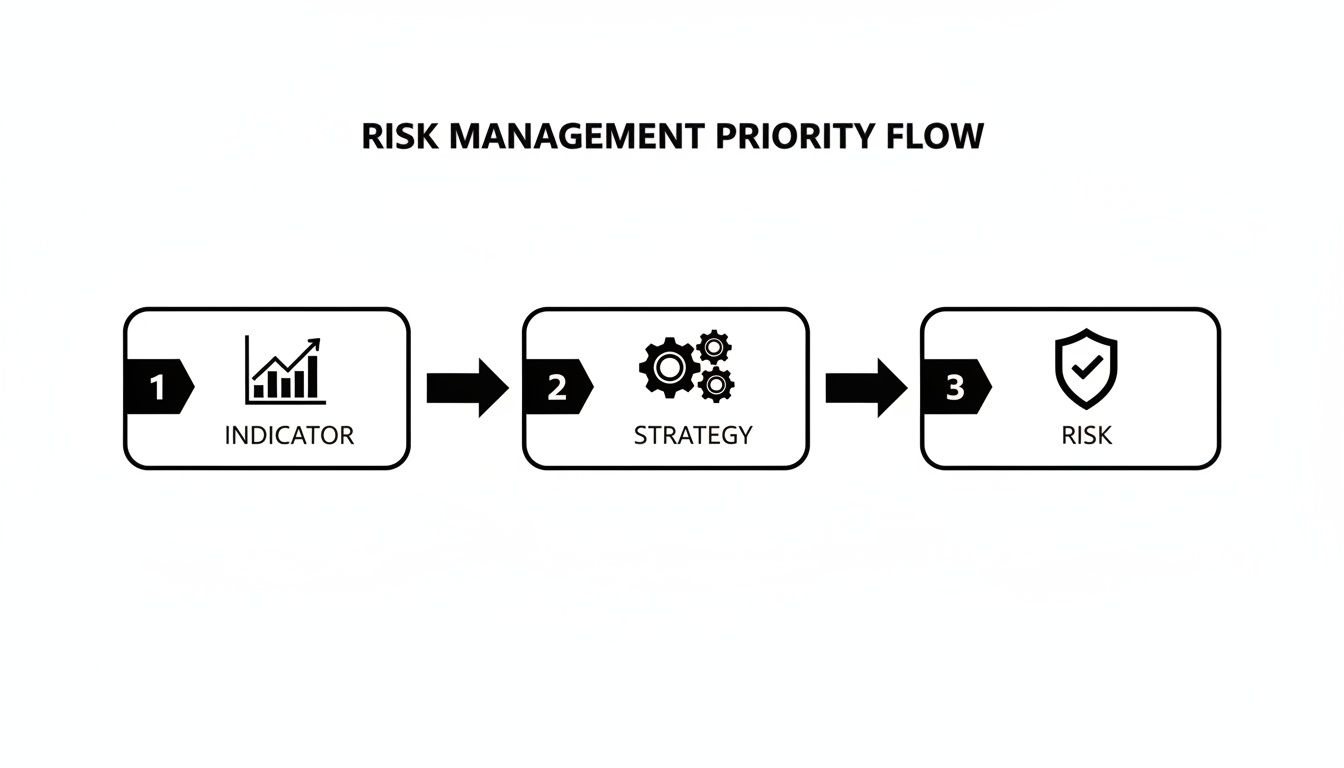
Your indicators and strategy might spot an opportunity, but your risk rules have the final say on whether that trade is worth taking.
Pillar 1: Define Your Risk Per Trade
Before hitting the "buy" or "sell" button, you must decide exactly how much of your account you are willing to lose on this single trade. For most disciplined traders, this is guided by the 1-2% rule.
This rule is simple: never risk more than 1% to 2% of your total account balance on any single trade.
- On a $10,000 account, 1% risk is $100.
- On a $100,000 account, 1% risk is $1,000.
This isn't an arbitrary number; it’s a mathematical necessity for survival. Risking just 5% per trade sounds small, but ten consecutive losses—which happens to everyone—will cut your account in half. At 1% risk, that same losing streak results in a much more manageable 10% drawdown. You can recover from that. This fixed percentage rule is your shield against emotion-driven decisions like revenge trading or getting overconfident after a winning streak.
Pillar 2: Calculate Your Position Size
Once you know your maximum risk in dollars, you must translate that into a specific trade size, known as your position size. This is a precise calculation based on the distance to your stop-loss.
A wider stop-loss requires a smaller position size to maintain your risk limit, while a tighter stop allows for a larger one. In both scenarios, the dollar amount you stand to lose remains exactly the same.
How to Calculate Position Size in 4 Steps
| Step | Action | Example ($100k Account, 1% Risk, 50 Pip Stop) |
|---|---|---|
| 1 | Determine Max Dollar Risk | $100,000 (Account) x 0.01 (Risk %) = $1,000 |
| 2 | Determine Stop-Loss Distance in Pips | Your entry is 1.0800, your stop is 1.0750. The distance is 50 pips. |
| 3 | Find the Pip Value | For EUR/USD, the value of one pip per standard lot is ~$10. Our example is $10. |
| 4 | Calculate Position Size (Lots) | [Dollar Risk] / ([Stop Pips] x [Pip Value]) = $1,000 / (50 x $10) = 2.0 lots. |
This calculation ensures you risk exactly $1,000, whether your stop is 25 pips away (allowing a 4.0 lot size) or 100 pips away (requiring a 1.0 lot size). For prop firm traders, this precision is critical for staying within strict drawdown limits. To learn more, you can learn more about how to calculate the maximum trailing drawdown in our FAQ.
Pillar 3: Set a Logical Stop-Loss
Your stop-loss must be placed based on market structure—not on a random number of pips or how much money you want to lose. A logical stop-loss is placed at a price level that, if reached, invalidates your original reason for taking the trade.
- For a long (buy) trade: Place your stop just below a recent swing low or a key support level.
- For a short (sell) trade: Place it just above a recent swing high or a key resistance level.
Avoid using arbitrary fixed-pip stops. Market volatility is constantly changing; a 20-pip move might be normal noise during a quiet session but a significant breakout during a volatile one. By anchoring your stop-loss to market structure, you let the market—not your profit and loss—tell you when your trade idea was wrong.
Advanced Risk Strategies for Active Traders
Once you have mastered the core pillars, you can layer in more sophisticated techniques. These strategies help you optimize performance, protect profits, and identify higher-quality trade setups.
Using the Risk-to-Reward Ratio
The Risk-to-Reward Ratio (RRR) compares how much you stand to gain versus how much you are risking on a trade. Before entering, it forces you to ask: "Is the potential reward worth the risk?"
Many professional traders will not take a trade with less than a 1:2 risk-to-reward ratio. This means for every $1 you risk, you have a realistic path to making at least $2.
- Risk: The distance from your entry to your stop-loss (e.g., 50 pips).
- Reward: The distance from your entry to your profit target (e.g., 100 pips).
With a 1:2 RRR, you can be profitable even if you only win 40% of your trades. By refusing to take trades that don't meet your minimum RRR, you automatically filter out mediocre setups and force yourself to be more selective.
Dynamic Trade and Profit Management
Active traders often manage their positions dynamically by adjusting their stop-loss as a trade moves into profit. This helps lock in gains and reduce risk.
Two common methods are:
- Moving to Break-Even: Once a trade moves in your favor (often by a 1:1 RRR), you move your stop-loss to your entry price. The worst that can happen is exiting with zero loss, turning the position into a "risk-free" trade.
- Using a Trailing Stop: This is a stop-loss that automatically follows the price as it moves in your favor, staying a fixed distance away (e.g., 50 pips). Trailing stops are excellent for trending markets, allowing you to ride a move as long as possible while protecting accumulated profits.
Understanding Currency Correlation Risk
Currency correlation is the tendency for certain currency pairs to move together or in opposite directions. For instance, EUR/USD and GBP/USD are highly correlated because both are priced against the U.S. dollar. If you go long on both pairs simultaneously, you haven't diversified your risk—you've doubled down on a single bet that the USD will weaken.
A sudden surge in dollar strength would hit both positions, effectively doubling your intended risk. Understanding correlations is crucial for managing your overall portfolio exposure. You can learn more about market dynamics and how the forex market's size impacts trading risk.
Adapting Your Risk Strategy for Prop Firm Rules
Trading for a prop firm means operating within a specific, non-negotiable set of rules. These rules, such as the 5% daily loss limit and 10% maximum drawdown, are not constraints but professional guardrails designed to build discipline.
Your entire risk strategy must be built around one goal: never breach these limits. A single day of undisciplined trading can result in a failed challenge or a revoked funded account.
Navigating Daily and Maximum Drawdown Limits
The daily loss and maximum drawdown limits force a level of discipline that many traders fail to apply to their personal accounts. The key is to create your own buffer zone.
Do not let the firm's 5% daily loss limit become your personal target. A smarter approach is to set your own, tighter personal hard stop. For example, you might decide to stop trading for the day after a 2% or 3% loss. This gives you a critical cushion, preventing a few bad trades from putting you in a dangerous position. This proactive approach to risk management in forex trading is what ensures you live to trade another day.
Practical Strategies for Staying Within the Rules
A clear, executable plan is essential for prop firm trading, especially under pressure.
Here are some concrete tactics to build into your trading plan:
- Calculate Risk Based on Drawdown: Your risk per trade should not be static. As you get closer to a drawdown limit, your risk must shrink. If you are approaching your maximum drawdown, consider reducing your risk to 0.5% or even 0.25% per trade to protect the account.
- Keep a Detailed Trading Journal: Track everything: entry rationale, stop-loss, take-profit, and your emotional state. This data is invaluable for identifying leaks in your strategy, such as over-trading or holding losers too long.
- Know When to Walk Away: If you hit your personal daily loss limit (e.g., 2% or 3%), you are done for the day. No exceptions. Close the platform and step away. This single habit is one of the most powerful tools for protecting your capital and career.
Mastering these habits is the cornerstone of trading with a funded trading account, as it demonstrates you can operate within a professional risk framework.
Your Daily Prop Firm Risk Checklist
Before placing your first trade of the day, run through this quick checklist:
- Check Drawdown Levels: What is my maximum daily loss limit in dollars? What is my absolute maximum drawdown level? I will not let my account equity touch these numbers.
- Set My Personal Daily Stop: My trading day ends if my account equity drops by [e.g., 2%].
- Define My Risk Per Trade: I will risk no more than [e.g., 1%] of my starting account balance on any single trade.
- Confirm My Stop-Loss and Position Size: Is my stop-loss placed at a logical level based on market structure? Have I calculated the correct position size to align with my risk plan?
This structured approach turns risk management from a vague idea into a concrete, daily practice.
How to Handle High-Impact News and Weekend Gaps
High-impact news events and weekend gaps can create massive volatility and significant risk. A clear plan for these periods is essential to protect your account from sudden, chaotic price moves.
Building a Game Plan for News Events
Major economic announcements like Non-Farm Payrolls (NFP) or central bank interest rate decisions can cause spreads to widen and slippage to occur, meaning your stop-loss may be filled at a much worse price than intended.
Here are three common approaches to trading the news:
- Trade Before the Announcement: This is essentially a gamble on the outcome and the market's reaction. It is an extremely high-risk strategy.
- Trade the Immediate Reaction: This involves entering moments after the release to catch the initial momentum. However, you are exposed to extreme volatility and "whipsaws," where the price violently reverses.
- Wait for the Dust to Settle: This is by far the safest strategy. Wait 15-30 minutes after the announcement for the market to digest the news, then look for a clear technical setup. You miss the initial spike but gain a much safer entry.
If you trade for a prop firm, know their specific rules. For example, MyFundedCapital allows traders on funded accounts to hold positions through news, but you must be prepared for the volatility. See our full policy on trading during news events.
Managing Weekend and Gap Risk
The forex market closes on Friday, but major geopolitical or economic events can occur over the weekend. This can cause the market to "gap" on Monday's open—opening at a significantly different price from its Friday close.
A weekend gap can jump right over your stop-loss, resulting in a much larger loss than planned.
To manage this risk:
- Go Flat on Friday: The simplest and safest approach is to close all open trades before the market closes for the weekend. This completely removes your exposure.
- Widen Stops and Reduce Size: If you must hold positions, use a much wider stop-loss to absorb a potential gap. This requires trading with a smaller position size to keep your dollar risk constant.
- Check the Geopolitical Climate: If there is a major election, G7 meeting, or escalating global tension, the odds of a gap are much higher. In these cases, it's often best to avoid holding positions over the weekend.
FAQs: Common Risk Management Questions
Here are answers to some of the most common questions beginner and intermediate traders have about risk management.
1. What is the best risk-to-reward ratio?
There is no single "best" ratio; it depends entirely on your strategy's win rate. A scalper with a 65% win rate might succeed with a 1:1.5 RRR. A trend-follower with a 40% win rate needs a much higher ratio, such as 1:3 or more, to ensure their larger wins cover their more frequent small losses. If you're just starting, a minimum of 1:2 is a solid benchmark.
2. How do I calculate position size?
To calculate your position size correctly, you need four pieces of information:
- Your total account balance
- Your risk percentage per trade (e.g., 1% or 0.01)
- Your stop-loss distance in pips
- The pip value for the currency pair
The formula is: Position Size (in Lots) = (Account Balance x Risk %) / (Stop Loss in Pips x Pip Value)
Example: For a $10,000 account, risking 1% ($100), with a 20-pip stop on EUR/USD (pip value ~$10):
Position Size = $100 / (20 pips x $10) = 0.5 lots.
3. Should I adjust my risk based on market volatility?
Yes, absolutely. While your risk percentage (e.g., 1%) should remain constant, your tactics must adapt. In a highly volatile market, you should use a wider stop-loss and a smaller position size to keep your dollar risk the same. In a quiet, low-volatility market, you can use a tighter stop, which allows for a slightly larger position size for the same dollar risk.
4. How does prop firm drawdown affect my risk management?
Prop firm drawdown rules are the most important boundaries for your strategy. A 5% daily loss limit means you must manage your risk per trade to avoid hitting this hard stop. Risking 1% per trade gives you a buffer of five consecutive losses. However, a safer approach is to set a personal daily stop-loss at 2-3%. This ensures a normal losing streak doesn't jeopardize your funded account and forces a higher level of professional discipline.
This content is for educational purposes only and should not be considered financial advice. All trading involves a substantial risk of loss.
Ready to apply these risk management principles in a professional trading environment? MyFundedCapital offers funding programs with clear rules designed to help you build the discipline needed for a long-term trading career.
Explore our funding programs and start your challenge today!

