

 NL
NL  EN
EN 
Getting a funded trading account means proving you can trade profitably while respecting a prop firm's rules, which usually involves passing an evaluation challenge. This guide provides a direct, step-by-step approach to help you choose the right firm, pass its evaluation, and manage your account professionally. You will learn the specific criteria to look for, how to prepare your strategy, and the mindset required for long-term success.
Your Path to a Funded Trading Account
Trading with your own capital has a clear ceiling based on your personal savings. A funded trading account breaks that limit by giving you access to significant capital—often $100,000 or more—in exchange for a share of the profits. This is a performance-based partnership: the prop firm provides the capital, and you provide the trading skill. When you profit, both parties win.
The proprietary trading model is growing rapidly, with the market projected to expand at a 6.5% CAGR through 2030. This growth is driven by technology and the increasing number of accessible funding programs for retail traders. Search interest for 'funded trader programs' has more than doubled since 2021, showing strong demand from traders who want to scale up without risking their own savings. You can learn more about these prop firm marketing trends to understand the industry's trajectory.
Why Traders Seek Funded Accounts
The appeal of a funded account goes beyond just capital. It enforces a professional level of discipline that can fundamentally improve your trading. Knowing that a strict drawdown rule violation means losing the account forces you to prioritize risk management and eliminate emotional trading mistakes.
Successful traders pursue funded accounts for several key reasons:
- Leverage Skills, Not Savings: It allows you to apply a proven trading edge to a larger capital base without risking personal funds.
- Structured Risk Environment: The firm's daily and maximum loss limits act as a safety net, preventing the catastrophic account blow-ups that can occur when trading alone.
- A Clear Path to Growth: Most reputable firms offer scaling plans, rewarding consistent traders with progressively larger accounts over time.
How to Choose the Right Prop Firm for Your Strategy
Your success with a funded account starts with choosing a prop firm that aligns with your trading style and goals. This is the most critical decision in the process. Selecting the wrong firm can mean their rules work directly against your strategy, making it nearly impossible to succeed.
For instance, a scalper needs tight spreads and fast execution, while a swing trader requires the ability to hold positions over weekends. Many traders fail because they rush into a challenge based on account size alone, without vetting the firm's rules. Let's break down how to choose wisely.
Aligning Rules with Your Trading Style
Every prop firm has a unique rulebook. A rule that is a minor inconvenience for one trader can be a deal-breaker for another. Before paying for a challenge, you must analyze the fine print.
Here are the key rules to investigate first:
- Weekend and Overnight Holding: If you are a swing trader, this is a must-have. Many firms require all positions to be closed on Friday, which invalidates any strategy based on multi-day timeframes.
- News Trading Restrictions: Some firms prohibit trading during major economic news releases due to volatility. If your strategy relies on trading these events, you need a firm that permits it.
- EA and Copy Trading Policies: If you use an Expert Advisor (EA) or copy trader, check the firm's policy. While many are EA-friendly, they often restrict high-frequency bots or generic, off-the-shelf EAs to ensure traders use unique strategies.
- Minimum Trading Days: This rule can force you to take low-probability trades just to meet a quota. Firms without this requirement offer greater flexibility to trade only when your edge is present.
Key Takeaway: Never adapt a proven strategy to fit a firm's rules. Find a firm whose rules naturally accommodate the way you already trade successfully.
Understanding the Financials
After confirming the rules fit your strategy, it's time to examine the financials. This includes everything from the entry fee to the profit split and payout schedule.
Prop Firm Feature Comparison Checklist
Use this table to systematically compare prop firms. This helps you look past the marketing and focus on the features that directly impact your trading.
| Feature | MyFundedCapital Offering | Other Firm (Example) | What to Look For |
|---|---|---|---|
| Weekend Holding | Allowed on all accounts | Not allowed | Crucial for swing traders. If you hold trades for more than a day, this is a must-have. |
| News Trading | Allowed on all accounts | Restricted | Essential if your strategy capitalizes on volatility during major economic events. |
| Max Drawdown Type | Static (based on initial balance) | Trailing (follows account high) | Static drawdown provides a fixed floor, making risk management simpler. Trailing drawdown is more restrictive and can be harder to manage. |
| Profit Split | Up to 90% | Typically 70-80% | Look for a high split, but make sure it's paired with achievable rules and a reliable payout system. |
| First Payout | 14 days after first trade | 30 days or more | How quickly can you access your earnings? Faster payouts improve your cash flow. |
| Payout Cadence | Bi-weekly | Monthly | Regular, frequent payouts (bi-weekly or even weekly) provide a more consistent income stream. |
| Trading Platforms | cTrader, DXtrade, Match-Trader | Usually just MT4/MT5 | Does the firm offer platforms that suit your needs? Some traders prefer the advanced charting and order types of platforms like cTrader. |
This checklist provides a solid foundation for making an informed decision and avoiding future surprises.
Evaluation Fees and Costs
Evaluation fees are an investment in your trading career. Finding a program that offers good value is essential. This is an area where you need to be strategic. MyFundedCapital offers various models, including instant funding that bypasses evaluation fees, alongside traditional 1-step and 2-step challenges with clear, upfront pricing. You can learn more about how the industry operates by reading our guide on what proprietary trading firms are and how they work.
Profit Splits and Payouts
The profit split—the percentage of profits you keep—is a major draw. While a high number like 80% or 90% is attractive, it's worthless if the rules make it difficult to get paid. A reliable and transparent payout process is more important.
Ask these questions:
- How soon after getting funded can I request my first payout?
- How often are payouts processed (e.g., bi-weekly, weekly)?
- What withdrawal methods are available (e.g., bank transfer, crypto)?
Comparing Drawdown Rules
Drawdown is the single most important rule in prop trading. Breaching it means losing the account. However, not all drawdown rules are created equal.
- Daily Drawdown: The maximum amount you can lose in a single day, typically calculated from the day's starting balance or equity. For example, a 5% daily drawdown on a $100,000 account means your equity cannot fall below $95,000 during that day.
- Maximum Drawdown: The total your account can lose from its initial balance or peak. Static drawdown is based on your starting balance and is straightforward. Trailing drawdown follows your account's high-water mark, making it more restrictive and challenging to manage.
Choosing a firm with clear, static drawdown rules simplifies risk management and allows you to focus on executing your strategy.
Getting Through Your Trading Challenge
You've selected a firm and are ready to begin the evaluation. This is where your discipline is tested under pressure. Many skilled traders fail not because their strategy is flawed, but because they cannot adapt to the firm's rules. Preparation is critical.
Passing a prop firm evaluation is difficult. Industry-wide, only about 5% to 10% of traders pass their initial challenges. The low success rate is often due to strict rules like the 5% daily and 10% maximum drawdown limits. A methodical plan is essential.
This flowchart outlines the decision-making process for choosing a firm. It emphasizes verifying rules, fees, and available trading instruments.
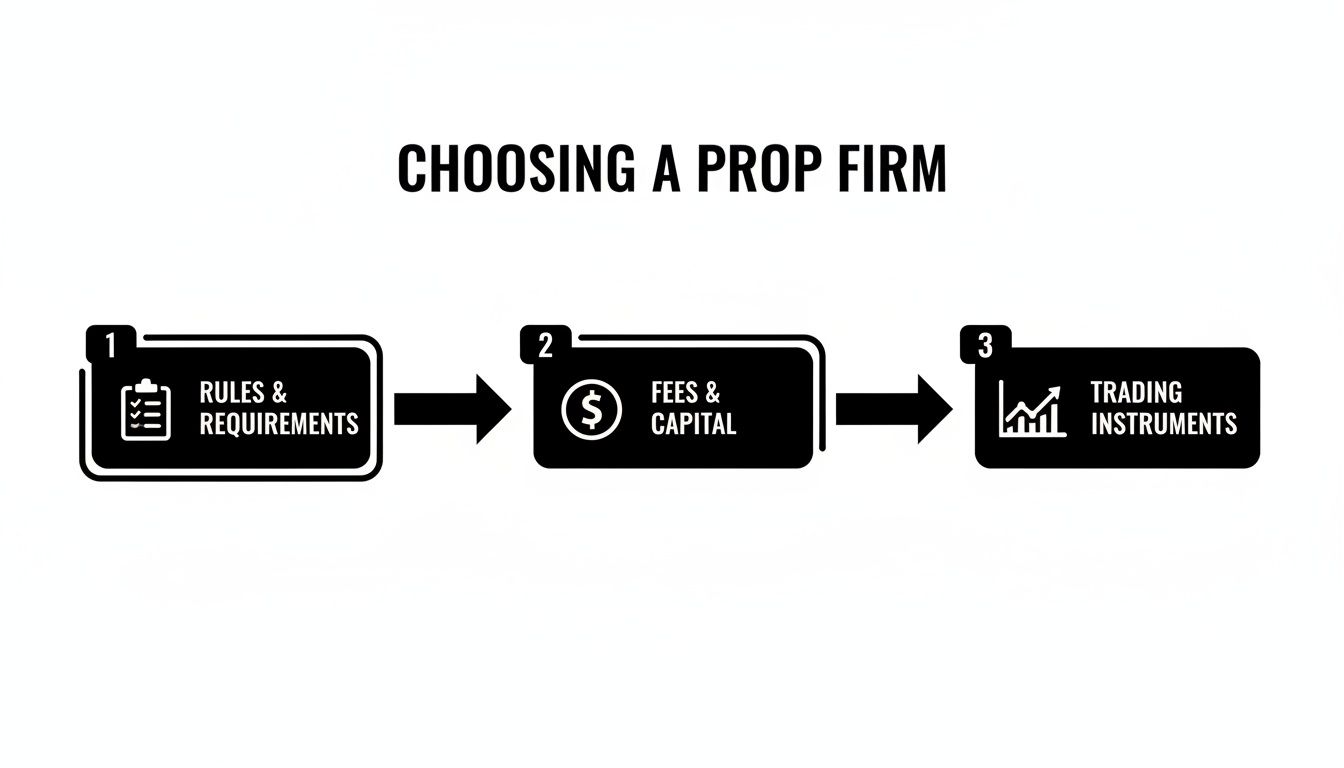
The key takeaway is to ensure your strategy is compatible with the firm's rules before considering fees or instruments.
Backtest Your Strategy Against Their Rules
Before paying for a challenge, you must backtest your strategy using the firm's exact risk parameters. It isn't enough to know your strategy is profitable; you must know if it can survive a 5% daily and 10% maximum drawdown.
For example, if your backtesting reveals a historical drawdown of 12%, it is incompatible with a firm that has a 10% max loss rule. You will need to reduce your risk per trade or modify your strategy to fit within the required constraints.
Build a Plan Just for the Challenge
You need a specific trading plan for the evaluation that prioritizes consistency over aggressive profit-seeking. This plan should be an unbreakable contract with yourself.
Your challenge plan must define:
- Max Risk Per Trade: Base your position size on the daily drawdown limit. On a $100K account with a 5% daily limit ($5,000), risking 1% ($1,000) per trade provides a buffer of five consecutive losses before hitting the daily limit.
- Personal Daily Stop-Loss: Set your own daily loss limit that is stricter than the firm's. If their hard stop is 5%, consider stopping for the day if you are down 2.5%. This prevents a bad day from turning into a failed challenge.
- Profit Pacing: Avoid trying to hit the profit target (e.g., 8% or 10%) in a single day. Break it down into smaller, manageable goals, such as 1-2% per week. This promotes sustainable trading and prevents reckless risk-taking.
The goal during a challenge is not to get rich. It's to prove you can manage risk like a professional. Profit is the byproduct of excellent risk management.
Choosing Your Path: The Different Challenge Types
Select a challenge type that aligns with your trading style and confidence.
- 1-Step Challenge: A single phase with a higher profit target, often around 10%. This is suitable for confident traders who want to get funded quickly.
- 2-Step Challenge: Two phases, with a lower profit target in the second phase (e.g., 8% in Phase 1, 5% in Phase 2). This is ideal for traders who prefer to build momentum and prove consistency over multiple stages.
- Instant Funding: This option skips the evaluation entirely, designed for experienced traders with a verifiable track record. Drawdown rules apply from day one.
Regardless of the path, success requires discipline, a tested strategy, and strict adherence to your risk plan. To learn more about how these models work, you can explore our guide on understanding prop firm challenges.
Managing Your Funded Account Like a Professional
Passing the evaluation is a significant accomplishment, but it's just the beginning. The aggressive, target-driven mindset required for the challenge must now be replaced with the discipline of a professional capital manager. Your primary objective shifts from hitting a profit target to preserving the firm's capital.
From High-Stakes Sprint to a Steady Marathon
Trading a funded account is psychologically different from the evaluation. The pressure of time limits and profit targets is gone, replaced by the need for relentless consistency. Many traders fail at this stage because they continue to force trades, ultimately hitting a drawdown limit.
Your focus must be on longevity. Think in terms of months and years, not days. Be highly selective and only take your highest-probability setups. Marginal trades that you might have considered during the challenge are now your biggest threat.
Hard truth: Prop firms are not looking for traders who make 20% in a week. They are hiring reliable risk managers who can generate steady, long-term returns.
Respect the Capital, Protect Your Career
The most successful funded traders treat the firm's capital with more respect than their own. An "it's just house money" attitude is a fast track to losing your account. An ironclad risk management framework is essential. Our guide on forex risk management strategies offers techniques applicable to any market.
Adopt these non-negotiable rules:
- Set Your Own Daily Loss Limit: The firm’s 5% daily drawdown is a safety net, not a goal. Set a tighter personal limit, such as 2% or 3%. Once you hit it, stop trading for the day.
- Keep Your Position Size Consistent: Avoid the temptation to increase your lot size after a winning streak. Consistent position sizing is fundamental to professional trading and prevents one bad trade from erasing a week's worth of profits.
- Focus on Flawless Execution, Not the Payout: Constantly watching your P&L leads to emotional mistakes. Concentrate on executing your plan perfectly. The profits will follow.
Understanding the Payout Process
Getting paid is the goal. Understanding your firm's payout process helps you manage expectations and treat trading like a business. At MyFundedCapital, the process is straightforward, with bi-weekly payouts for challenge programs and options for faster access to profits.
Typically, you submit a withdrawal request through your dashboard, and the firm processes your profit share via bank transfer or crypto. This predictable cycle—perform, get paid, repeat—is what turns trading into a viable career.
Growing Your Account and Taking Home More Profit
Passing your challenge is just the first step. The real potential of prop firm trading lies in scaling your account and increasing your profit share. This is how you transition from proving your strategy to building a scalable trading business.
The Path to a Bigger Account
Reputable prop firms reward their top traders with scaling plans. These plans are based on clear performance milestones. For example, if you achieve a 10% profit target over three months on a $100,000 account without any rule violations, the firm may increase your capital to $150,000 or $200,000. This creates a powerful feedback loop where success fuels future growth.
Caution: Do not change your strategy or over-leverage to hit a scaling target faster. The best way to scale is to continue executing the same disciplined strategy that got you funded.
Gradually increasing your capital is a game-changer. Your standard 1% risk per trade now represents a larger dollar amount, allowing your profits to compound without altering your core strategy.
Earning a Bigger Slice of the Pie
As you scale your capital, many firms also offer an increased profit split. While an 80% split is a great start, consistent traders can often earn up to 90%. This is another way firms reward long-term, disciplined traders.
The requirements for a higher split are often tied to the scaling plan. For instance, you might be offered a better split after your first successful account scale or after several consecutive profitable months.
Here’s a possible progression:
- Start: Standard 80% profit split.
- After First Scale: Split increases to 85%.
- As a Top Trader: Reach the top-tier 90% split.
This structure aligns the firm's interests with yours, creating a partnership where discipline and loyalty are directly rewarded.
Playing the Long Game: A Career Mindset
Thinking about how to get a funded trading account should extend beyond passing the challenge. The real goal is to build a sustainable career. View scaling plans and profit split increases as part of your long-term business plan.
Keep these principles in mind:
- Consistency Trumps Intensity: A series of small, steady gains is far more valuable than a volatile mix of large wins and losses.
- Protect the Capital: Your primary job is risk management. Profitability is a byproduct of doing this well.
- Patience Pays: Do not force the scaling process. Let it happen organically as a result of disciplined trading.
Adopting this long-term perspective elevates you from a "funded trader" to a professional capital manager, building a track record that is valuable both to your current firm and the broader proprietary trading industry.
FAQ: Common Questions About Funded Trading Accounts
Here are straightforward answers to some of the most common questions from aspiring funded traders.
What are the most common reasons traders fail funding challenges?
The most common reason for failure is a breakdown in risk management, often driven by emotion. Traders violate the daily or maximum drawdown rules by taking oversized positions or revenge trading after a series of losses. Another major pitfall is a mismatch between a trader's style and the firm's rules, such as a swing trader choosing a firm that doesn't allow weekend holding. Passing a challenge requires executing a profitable strategy within a specific, non-negotiable set of rules.
Can I use trading bots or EAs to get a funded account?
Yes, many prop firms, including MyFundedCapital, allow the use of Expert Advisors (EAs). However, you must read their specific rules on algorithmic trading. Most firms prohibit certain strategies, such as high-frequency trading (HFT), arbitrage, or using generic, off-the-shelf EAs that many other traders are also using. Your bot should be an extension of your own unique, proven strategy. Always verify the firm's policy to avoid a rule violation.
How do payouts work and are they reliable?
For any reputable prop firm, the payout process is reliable and straightforward. Firms that fail to pay their successful traders do not last long. The process typically involves reaching your payout eligibility date (e.g., weekly, bi-weekly), requesting a withdrawal through your trader dashboard, and receiving your profit share via methods like bank transfer or crypto. As long as you are profitable and follow the rules, a trustworthy firm will ensure you get paid on time.
What happens if I break a rule on a live funded account?
If you violate a major rule, particularly the daily or maximum drawdown, on a live funded account, the account is typically terminated immediately. You will lose access to the account and forfeit any unpaid profits. This is why risk management is even more critical after you are funded. Most firms do not offer a second chance on a breached live account, though you are usually welcome to purchase a new evaluation and try again. It's a strict but necessary measure that enforces the professional discipline required for long-term success.
Disclaimer: Trading involves substantial risk of loss and is not suitable for all investors. This content is for educational purposes only and is not financial advice.
Ready to prove your skills and take the next step in your trading career? MyFundedCapital offers clear paths to funding with realistic rules designed for disciplined traders.
Explore our funding programs and find the right fit for your strategy.

