

 EN
EN  DE
DE 
Developing effective strategies for algo trading can be a major challenge, especially when trying to remove emotion and human error from your decisions. This article breaks down ten proven algorithmic strategies, explaining how they work and when to use them. You will learn practical steps, key indicators, and risk management techniques for each approach.
1. Mean Reversion Trading
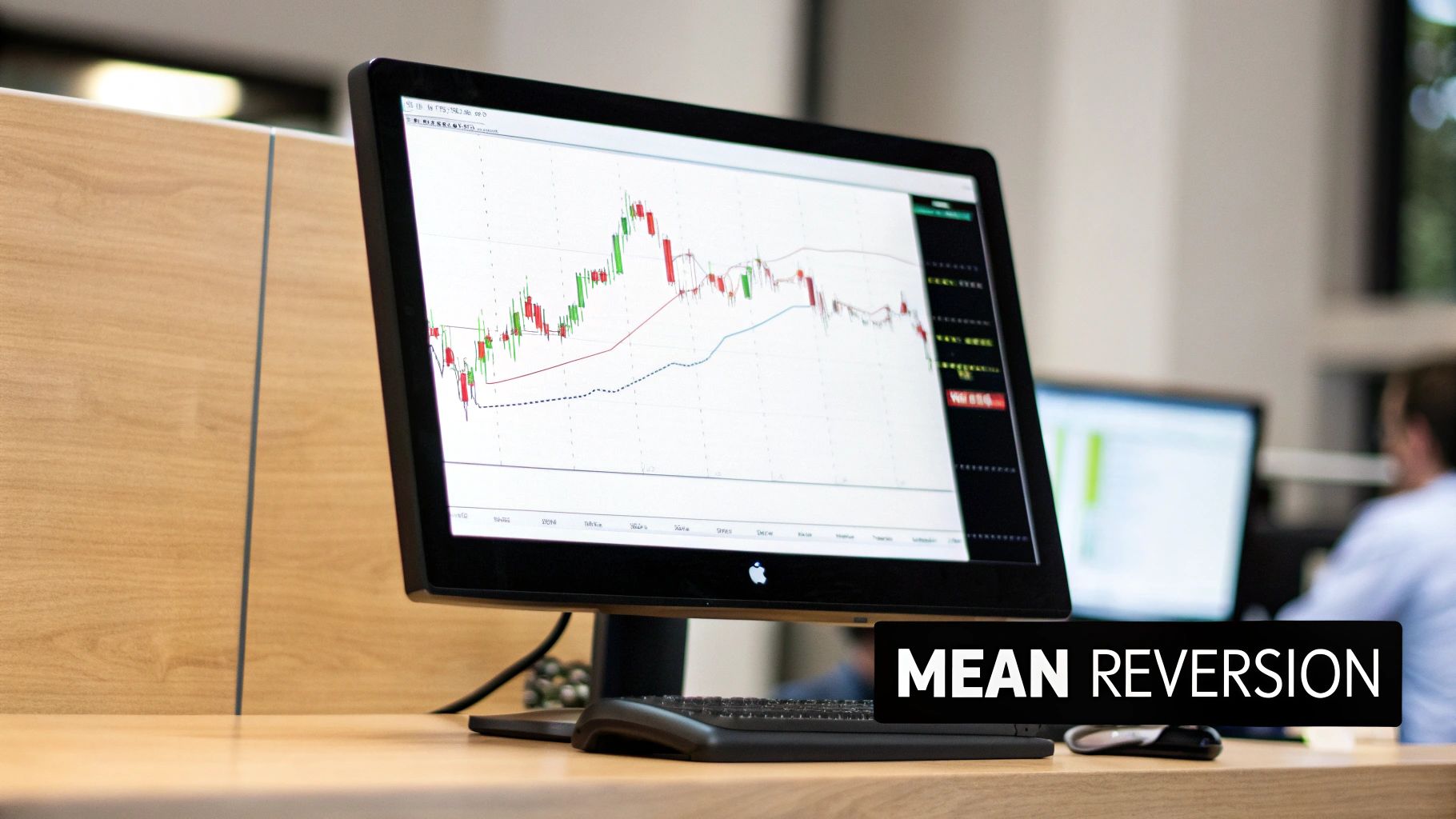
Mean reversion is built on the idea that asset prices tend to return to their historical average after an extreme move. An algorithm using this strategy identifies when a price has deviated significantly from its mean and executes trades that anticipate a return to that average. This is a foundational strategy that works well in markets that are range-bound or consolidating.
How to Implement It
- Trigger Condition: Price moves a certain number of standard deviations away from a moving average.
- Action:
- If price hits the upper Bollinger Band (e.g., 2 standard deviations above the 20-period moving average), place a SELL order.
- If price hits the lower Bollinger Band, place a BUY order.
- Exit Condition:
- Take profit when the price returns to the moving average (the middle band).
- Set a stop-loss just beyond the recent high/low that triggered the trade (e.g., 1.5x ATR).
Practical Example
- Asset: EUR/USD on a 15-minute chart.
- Setup:
- Indicator: Bollinger Bands (20 periods, 2 standard deviations).
- Entry: Price touches the upper band at 1.0750. The algorithm sells 1 lot.
- Stop-Loss: Set at 1.0765 (15 pips above entry).
- Take-Profit: Target the middle band, currently at 1.0720.
Risk Management
Mean reversion can fail in a strong trend. Always use a hard stop-loss. Avoid using this strategy during high-impact news events that can trigger new trends. You can learn more about VWAP and its role in trading to better identify market equilibrium.
2. Momentum Trading / Trend Following
Momentum trading, or trend following, is a strategy designed to capitalize on existing market trends. The algorithm identifies assets with strong directional movement and trades in the same direction, aiming to ride the trend as long as possible. The core principle is simple: buy high and sell higher, or sell low and buy back lower.

How to Implement It
- Trigger Condition: A short-term moving average crosses over a long-term moving average.
- Action:
- If the 50-period EMA crosses above the 200-period EMA, place a BUY order.
- If the 50-period EMA crosses below the 200-period EMA, place a SELL order.
- Exit Condition:
- Use a trailing stop-loss to lock in profits as the trend continues.
- Exit if the moving averages cross back in the opposite direction.
Practical Example
- Asset: NASDAQ 100 (NAS100) on a 1-hour chart.
- Setup:
- Indicators: 50-period EMA and 200-period EMA. ADX > 25 to confirm trend strength.
- Entry: The 50 EMA crosses above the 200 EMA at 18,500. ADX is 30. The algorithm buys.
- Stop-Loss: Use a trailing stop set to 2x the 14-period ATR.
- Take-Profit: No fixed target; let the trailing stop exit the trade when momentum fades.
Risk Management
The biggest risk is a false signal in a choppy market. Use a filter like the Average Directional Index (ADX) to ensure you only trade when a strong trend is present (e.g., ADX > 25).
3. Statistical Arbitrage / Pairs Trading
Pairs trading is a market-neutral strategy that profits from pricing inefficiencies between two historically correlated assets. The algorithm finds two instruments that typically move together. When their price spread widens, it buys the underperforming asset and sells the outperforming one, betting that the spread will revert to its historical average.
How to Implement It
- Trigger Condition: The price spread between two correlated assets (e.g., WTI Crude Oil vs. Brent Crude Oil) deviates by a set amount (e.g., 2 standard deviations) from its historical mean.
- Action:
- If the spread is too wide, short the stronger asset and buy the weaker one.
- Exit Condition:
- Close both positions when the spread returns to its mean.
Practical Example
- Asset Pair: Bitcoin (BTC) and Ethereum (ETH).
- Setup:
- Analysis: Calculate the price ratio (BTC/ETH) over the last 60 days to find its mean and standard deviation.
- Entry: The current ratio moves 2 standard deviations above the mean. The algorithm sells BTC and buys an equivalent dollar amount of ETH.
- Stop-Loss: If the spread widens to 3 standard deviations, close the trade to prevent large losses if the relationship has broken.
- Take-Profit: When the ratio returns to its 60-day mean.
Risk Management
The core risk is that the historical relationship between the pair breaks down permanently. Periodically re-test the correlation and use a stop-loss based on the spread itself, not just individual asset prices.
4. Grid Trading
Grid trading automates buying and selling by placing orders at preset intervals around a price. This "grid" of orders is designed to profit from market volatility within a range. The algorithm buys as the price falls to a grid level and sells as it rises, capturing small, consistent profits from price fluctuations.
How to Implement It
- Trigger Condition: Price crosses a predefined grid line.
- Action:
- Set a price range (e.g., 1.0700 to 1.0800 for EUR/USD).
- Place buy orders at set intervals (e.g., every 20 pips) below the current price and sell orders at intervals above it.
- Exit Condition:
- Each buy order has a corresponding take-profit at the next grid level up.
- Each sell order has a take-profit at the next grid level down.
Practical Example
- Asset: USD/JPY in a range between 155.00 and 156.00.
- Setup:
- Grid Size: 25 pips.
- Orders: Place buy orders at 155.75, 155.50, 155.25, and 155.00. Place sell orders at 156.25, 156.50, etc.
- Logic: If price drops and fills the buy at 155.50, a take-profit order is automatically set for it at 155.75.
- Stop-Loss: If the price breaks the entire range (e.g., drops below 155.00), close all open positions to cap the loss.
Risk Management
Grid trading is dangerous in a strong trend, as it can accumulate many losing positions. Always define a maximum range for your grid and use a stop-loss to close all trades if that range is broken.
5. Scalping / High-Frequency Trading
Scalping algorithms execute a high volume of trades for tiny profits, often lasting just seconds or minutes. This strategy relies on speed, low transaction costs, and high liquidity to capitalize on small price movements or bid-ask spread inefficiencies.
How to Implement It
- Trigger Condition: An order book imbalance or a micro-level technical signal.
- Action:
- Use a fast oscillator like the Stochastic (set to a fast period like 5,3,3) on a 1-minute chart.
- Buy when the oscillator crosses above 20 (oversold).
- Sell when the oscillator crosses below 80 (overbought).
- Exit Condition:
- Take profit after a small, fixed gain (e.g., 3-5 pips).
- Use a very tight stop-loss (e.g., 5-7 pips).
Practical Example
- Asset: EUR/USD during the London-New York session overlap for maximum liquidity.
- Setup:
- Platform: cTrader or DXtrade for low-latency execution.
- Entry: 1-minute Stochastic crosses below 80. Algorithm sells immediately.
- Stop-Loss: 5 pips.
- Take-Profit: 4 pips.
Risk Management
Success depends on execution speed and low costs. One large loss can erase hundreds of small wins. A hard stop-loss on every single trade is non-negotiable. For more insights on micro-level trading, you can learn more about trading the tick.
6. Machine Learning / AI-Driven Prediction
This advanced strategy uses AI models to predict future price movements based on vast amounts of data. Unlike rule-based systems, ML algorithms can identify complex patterns and adapt to changing market conditions. The goal is to build a model that forecasts price direction with a statistical edge.

How to Implement It
- Trigger Condition: The ML model predicts a high probability of a price move.
- Action:
- Train a model (e.g., a Random Forest classifier) on historical data using features like RSI, MACD, and ATR. The target is to predict if the price will be higher or lower in the next hour.
- If the model predicts "UP" with >70% confidence, place a BUY order.
- Exit Condition:
- Exit after a fixed time (e.g., 1 hour) or use a standard stop-loss and take-profit.
Practical Example
- Asset: S&P 500 (SPX500).
- Setup:
- Features: 14-period RSI, MACD values, 14-period ATR, and price change over the last 3 periods.
- Model Output: A probability score (0-1) for an upward move.
- Entry: Model outputs a score of 0.85. The algorithm buys.
- Stop-Loss: Set at 0.5% below the entry price.
- Take-Profit: Set at 1% above the entry price.
Risk Management
The biggest danger is "overfitting," where a model looks perfect on past data but fails in live trading. Use out-of-sample data for testing and implement an independent risk management layer that can override the model's decisions.
7. Breakout Trading
Breakout trading is a momentum strategy that aims to capture the start of new trends. The algorithm identifies key support and resistance levels and executes a trade when the price moves decisively through them, often confirmed by a surge in volume.
How to Implement It
- Trigger Condition: Price closes above a significant resistance level or below a support level.
- Action:
- Identify a consolidation pattern like a triangle or range.
- Place a buy stop order just above the range's high and a sell stop order just below its low.
- Exit Condition:
- Use a trailing stop-loss to ride the new trend.
- A common take-profit target is the height of the previous consolidation range projected from the breakout point.
Practical Example
- Asset: Gold (XAU/USD) on a 4-hour chart.
- Setup:
- Level: Gold has been ranging between $2,330 and $2,350 for two days.
- Entry: Price breaks and closes above $2,350 with high volume. The algorithm buys.
- Stop-Loss: Place a stop at $2,345, just back inside the previous range.
- Take-Profit: The range was $20 high, so a potential target is $2,370 ($2,350 + $20).
Risk Management
False breakouts ("whipsaws") are common. To reduce them, confirm breakouts with a volume increase or wait for a retest of the broken level before entering. To understand these patterns better, you can learn more about common chart patterns here.
8. Options Selling / Income Generation
This strategy focuses on generating consistent income by selling options contracts and collecting the premium. The algorithm identifies opportunities to sell options where the statistical probability of them expiring worthless is high. It profits from time decay (theta) and decreases in volatility.
How to Implement It
- Trigger Condition: Implied volatility (IV) is high (e.g., IV Rank > 50), making options premium expensive.
- Action:
- Sell a defined-risk options spread, like a put credit spread, far out-of-the-money.
- Exit Condition:
- Close the trade when you've captured 50% of the maximum potential profit.
- Close the trade if it reaches a predefined max loss (e.g., 2x the premium received).
Practical Example
- Asset: SPY (S&P 500 ETF).
- Setup:
- Condition: IV Rank is at 60.
- Trade: Sell a put credit spread with 45 days to expiration (DTE) and a delta below 0.15. For example, sell the 490 put and buy the 485 put for a $0.50 credit per share ($50 per contract).
- Max Profit: $50.
- Max Loss: $450.
- Take-Profit: Close the position if the value of the spread drops to $25.
Risk Management
Never sell naked options, as the risk is theoretically unlimited. Always use defined-risk spreads like credit spreads or iron condors to cap your maximum potential loss.
9. Volatility Trading / VIX Strategies
Volatility trading profits from changes in market volatility itself, rather than price direction. The algorithm trades instruments tied to volatility, like the VIX index, or uses options to create positions that benefit when volatility spikes or falls.
How to Implement It
- Trigger Condition: A volatility index like the VIX reaches an extreme level.
- Action:
- If the VIX is historically low (e.g., below 12), buy VIX call options or a VIX ETP in anticipation of a future spike.
- If the VIX is historically high (e.g., above 30), sell VIX futures or a call spread, betting that volatility will revert to its mean.
- Exit Condition:
- Exit when volatility returns to its historical average.
Practical Example
- Asset: VIX Index.
- Setup:
- Condition: A market panic sends the VIX soaring to 40.
- Trade: The algorithm sells a VIX call spread, betting it will fall.
- Stop-Loss: If the VIX continues to rise to 45, close the trade.
- Take-Profit: When the VIX drops back to 25.
Risk Management
Volatility can move extremely quickly. Use options or defined-risk futures spreads to cap your risk. Be aware that many long-volatility products suffer from decay ("contango") and are not suitable for long-term holds.
10. Sentiment Analysis / Market Microstructure
Sentiment analysis uses data from news articles, social media, and other sources to gauge market mood. The algorithm identifies when sentiment reaches an extreme (e.g., "extreme fear" or "extreme greed") and takes a contrarian position, betting on a reversal.
How to Implement It
- Trigger Condition: A sentiment indicator reaches an extreme reading.
- Action:
- Monitor a Fear & Greed Index or a social media sentiment score for a specific asset.
- If the index drops into "extreme fear" (e.g., below 20) while the price is at a key support level, place a BUY order.
- Exit Condition:
- Exit when sentiment returns to a neutral level or when a technical profit target is hit.
Practical Example
- Asset: Bitcoin (BTC/USD).
- Setup:
- Indicator: Crypto Fear & Greed Index.
- Entry: After a sharp sell-off, the index drops to 15 ("Extreme Fear"). The algorithm buys BTC.
- Stop-Loss: A price-based stop-loss below the recent low.
- Take-Profit: When the index climbs back above 50 ("Neutral").
Risk Management
Sentiment can remain irrational for long periods. Never use sentiment as your only signal. Always combine it with technical analysis (like support/resistance levels) to confirm your entry and define your risk.
Frequently Asked Questions (FAQ)
1. Which programming language is best for algo trading?
Python is the most popular choice due to its extensive libraries for data analysis (Pandas, NumPy), machine learning (Scikit-learn, TensorFlow), and backtesting (Backtrader, Zipline). For high-frequency strategies requiring maximum speed, C++ is often preferred.
2. Can I run an automated strategy in a prop firm challenge?
Yes, most prop firms, including MyFundedCapital, allow the use of expert advisors (EAs) and automated strategies. However, you must ensure your algorithm adheres to all the firm's rules, especially those regarding maximum daily and total drawdown.
3. How much capital do I need to start algo trading?
The capital required depends on the strategy and broker. However, using a prop firm challenge allows you to trade with significant capital (e.g., $5,000 to $200,000) for a small initial fee, making it an accessible way to start without risking a large amount of personal funds.
Ready to Test Your Algorithmic Strategies?
Building and testing automated trading strategies is a demanding but rewarding process that requires discipline, skill, and a robust framework for managing risk. The key to success is not finding a "perfect" system but developing a process for creating, validating, and deploying strategies that have a statistical edge.
Remember, all trading involves significant risk of loss. The content in this article is for educational purposes only and is not financial advice. Past performance is not indicative of future results.
Take the next step in your trading journey. MyFundedCapital offers a platform where you can deploy your strategies for algo trading and prove your skills.

