

 EN
EN  DE
DE 

Staring at a prop firm’s rulebook can feel like trying to read a foreign language, and misunderstanding a key rule can end your funded account instantly. This guide will explain exactly what a trailing drawdown is, how it's calculated with real numbers, and how to manage it so you can stay in the game.
Think of it as a moving safety net. It’s a dynamic risk limit that follows your profits as they grow, designed to protect both the firm's capital and the gains you’ve worked hard to achieve. Understanding this rule isn't just about passing a challenge—it's about developing the discipline of a professional trader.
Understanding Trailing Drawdown: A Trader's Moving Floor
Imagine you're trading a $100,000 account with a typical fixed drawdown of 10%. Your safety net is always at $90,000, no matter how high your account grows. It's simple and predictable.
A trailing drawdown is different. It’s a risk management tool that moves up as you make profits, forcing you to protect your gains. Every time your account hits a new high, your minimum allowed balance—that safety net—gets pulled up right behind it.
Here’s the most important part: the net only moves up, never down.
If you make a profitable trade and your account balance grows, the floor rises. If you then hit a losing streak, your balance drops, but that safety net stays at its new, higher level. This makes your available buffer—the space between your current balance and the violation level—tighter, pushing you to manage risk with extreme discipline.
Why Prop Firms Use This Rule
Proprietary trading firms use the trailing drawdown to filter out inconsistent traders from disciplined professionals. It serves two critical functions:
- Protecting Capital: First and foremost, it shields the firm's starting capital. The limit ensures that no single trader can lose more than a predetermined amount from the account's peak performance.
- Forcing Consistency: It rewards traders who build their accounts steadily. At the same time, it quickly penalizes those who take massive risks or let a huge winning position reverse into a major loss.
This approach has become an industry standard. In fact, a 2023 industry analysis revealed that accounts with trailing drawdown rules saw 35% fewer breaches than those with simple static limits. This statistic, highlighted in a report on TradeFundrr.com, shows just how effective it is at building better trading habits.
Learning to master this rule isn't just about passing an evaluation. It's about developing the discipline that defines a professional trading career. Trading involves substantial risk of loss and is not suitable for all investors. This content is for educational purposes only and is not financial advice.
How to Calculate Your Trailing Drawdown
Let's break down the math. The formula for a trailing drawdown is simple, but the details can easily trip you up if you’re not paying close attention.
The basic calculation is:
Breach Level = Highest Account Balance – Allowed Drawdown Amount
The "Highest Account Balance" is your high-water mark. As your account grows, this high-water mark moves up, pulling your breach level along with it. But it never goes back down, even if your account balance takes a hit.
A Step-by-Step Calculation Example
Let's use a practical example. You're trading a $100,000 funded account with a $5,000 trailing drawdown rule.
- Day 1: You start with $100,000. Your breach level is immediately set at $95,000 ($100,000 – $5,000). Your account cannot drop below this number.
- You Make a Profit: You have a good trading day and your balance climbs to a new peak of $102,000. This is your new high-water mark. Your trailing drawdown limit is instantly recalculated and moves up to $97,000 ($102,000 – $5,000).
- You Take a Loss: The next day, you take a $1,000 loss, bringing your balance to $101,000. This is the key moment: your breach level does not move down. It stays locked at the $97,000 level set by your previous peak.
This is the "trailing" part in action. It shows how the safety net follows your profits up but holds its ground when you have a losing trade. Your risk buffer is the space between your current balance ($101,000) and your locked-in floor ($97,000). For a deeper look into how these figures are tracked, our guide on what PnL stands for in trading is a great resource.
The whole process creates a safety net that trails behind your success, as this graphic shows.
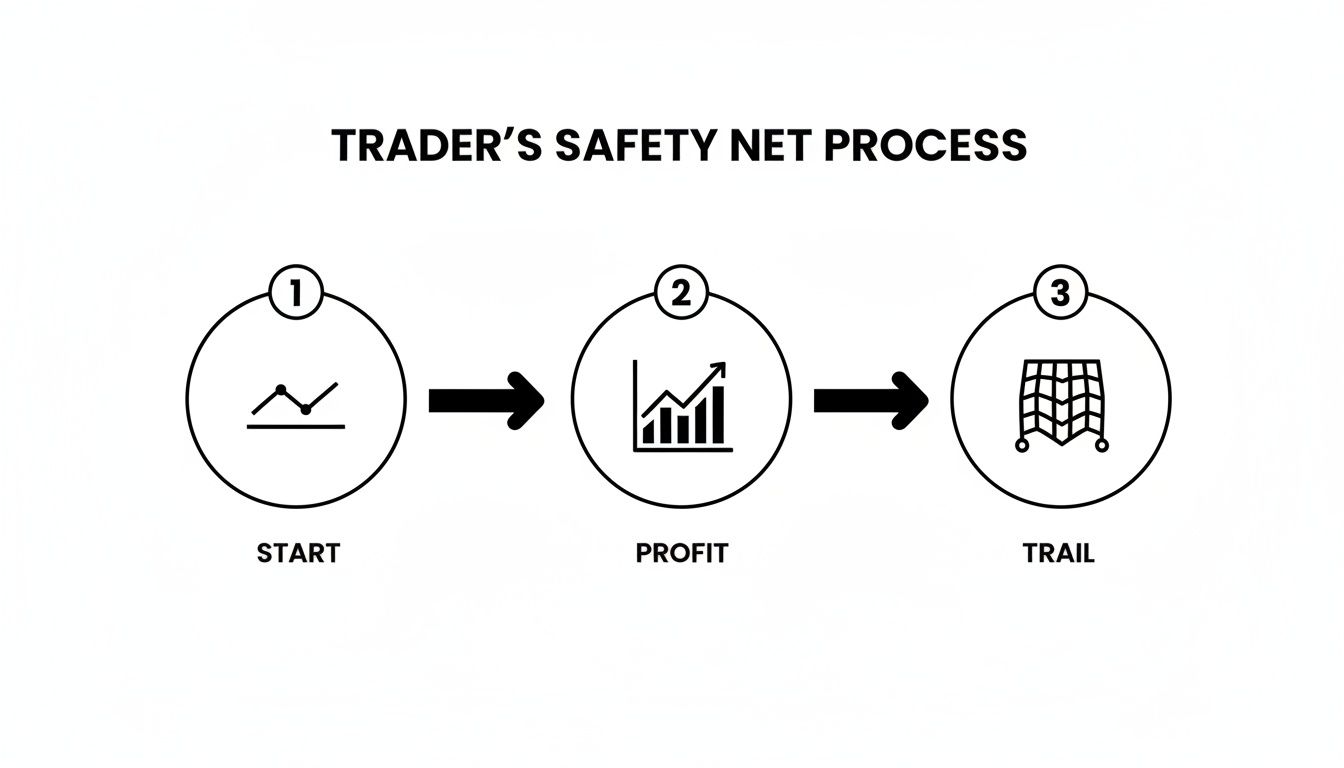
As you build profits, the firm's rules ensure you protect those gains by raising the minimum level your account can fall to. It forces you to become more disciplined as you become more successful.
The Most Important Rule to Remember
If you take one thing away from this section, let it be this: the trailing drawdown is a one-way street.
Your breach level can only move in one direction: up. Once your account sets a new high-water mark, the floor is permanently raised to that new level, protecting both the firm’s capital and your accumulated profits.
Understanding this concept is non-negotiable. Before placing any trade, you must know two numbers: your current high-water mark and your absolute breach level.
Trailing Drawdown in Real Trading Scenarios
Theory is one thing, but seeing how a trailing drawdown plays out in the heat of the moment is another. Let’s walk through two common trading scenarios to see how this rule works in practice. One misstep can mean losing your funded account.
Scenario 1: The EUR/USD Scalper (Balance-Based)
Alex is a scalper on a $100,000 account with a $5,000 trailing drawdown. His firm calculates the drawdown based on his closed balance.
- Starting Point: Account balance is $100,000, so his breach level is $95,000.
- Winning Streak: Alex has a great morning, banking $1,500 in profit. His new balance is $101,500, which becomes his new high-water mark.
- The Trail Follows: Instantly, his breach level trails up to $96,500 ($101,500 – $5,000).
- Sudden Reversal: Unexpected news hits the market. He takes a $2,000 loss, dropping his balance to $99,500.
Even though Alex is still up $4,500 from his starting balance, his risk buffer has shrunk. His breach level is locked at $96,500, leaving him with only $3,000 of room before he violates the rule. This is a classic example of how a series of small wins can pull your floor up, leaving you vulnerable to a single large loss.
Scenario 2: The NAS100 Swing Trader (Equity-Based)
Maya is a swing trader with the same $100,000 account and $5,000 trailing drawdown. However, her firm calculates it based on real-time equity (your balance plus open PnL).
Maya goes long on NAS100, and the trade immediately shows a floating profit of $4,000.
This is the crucial part: Her account equity is now $104,000 ($100,000 balance + $4,000 open profit). The prop firm's system sees this as the new high-water mark. Her trailing drawdown limit instantly jumps from $95,000 to $99,000 ($104,000 – $5,000), even though she hasn't closed the trade.
The market then pulls back hard, and her floating profit shrinks to $1,000. Her equity is now $101,000. The trade is still profitable, but her breach level is stuck at $99,000. She now only has a $2,000 buffer. If that position keeps reversing, she could breach the rule on what started as a "winning" trade.
This equity-based calculation is far more aggressive and a major reason why many traders fail challenges. A 2023 analysis found 62% of failures were due to traders hitting their trailing thresholds during intraday price swings. You can dig deeper into these findings on trailing drawdown from QuantVPS.
The lesson is simple: always confirm whether your prop firm uses balance or equity to set your high-water mark. It makes all the difference.
End of Day vs. Real-Time Drawdown: What You Need to Know
Not all trailing drawdowns are created equal. The fine print in your prop firm's rules can make or break your trading, and one of the most critical details is whether they use an End-of-Day (EOD) or Real-Time drawdown.

End-of-Day (EOD) Drawdown
An End-of-Day (EOD), or balance-based, drawdown is the more forgiving of the two. With this rule, your high-water mark is only updated once per day, based on your account's closed balance. This means you can ride out significant intraday equity swings without your breach level moving. It is often a better fit for swing traders.
Real-Time Drawdown
A Real-Time (or equity-based) drawdown is the stricter version. This type updates your high-water mark continuously, tracking your account's highest floating equity in real-time. If you have a large unrealized profit that pulls back, your breach level will have already moved up, locking in that higher floor. This demands very tight risk management and suits scalpers or intraday traders.
The difference is critical: EOD is calculated on your closed profits at day's end. Real-Time is calculated on your highest unrealized profit, moment by moment.
Which Drawdown Type Is Right for You?
The right choice depends on your trading style. Data suggests that 55% of index traders succeed with EOD rules, while only 32% of intraday crypto traders—who often face 24/7 real-time calculations—do. You can explore more about these findings and their implications on PropFirmApp.
Here’s a quick breakdown:
| Drawdown Type | Pros | Cons |
|---|---|---|
| End-of-Day (EOD) | – Allows for intraday volatility – Less stressful to manage – Good for swing or position traders |
– Slower to lock in and protect profits – May encourage holding losers too long |
| Real-Time | – Forces disciplined profit-taking – Protects gains immediately – Suits scalpers and high-frequency traders |
– Extremely strict and unforgiving – High risk of a breach from pullbacks – Can be psychologically draining |
Neither is "better"—only the one that fits your strategy. Always read the fine print before starting a prop firm challenge.
How to Manage Risk with a Trailing Drawdown
Successfully trading under a trailing drawdown rule isn't about avoiding losses—it's about managing them intelligently. The goal is to obsessively protect your drawdown cushion.
Your drawdown cushion is the dollar amount between your current account equity and the breach level. It’s your lifeline. Protecting it is your number one job.
Stick to a Fixed Risk Per Trade
The most effective strategy is to base your risk on your initial balance, not your current equity. Stick to a small, consistent risk, like 0.5% to 1% per trade.
- On a $100,000 account, a 1% risk is $1,000.
- Even if your account grows to $105,000, your risk should remain a fixed $1,000, not 1% of the new balance ($1,050).
- This discipline stops your risk from creeping up and gives you a much better chance of surviving a market reversal.
For a deeper dive, check out our guide to risk management in forex trading.
Take Partial Profits
A classic trap with a real-time trailing drawdown is watching a huge floating profit push your breach level up, only to see the market reverse. The solution is to take partial profits.
When a trade is deep in profit, consider closing 50% of the position to lock in the gain. This banks a real profit, protects your cushion, and still leaves the rest of the position open to catch more upside.
This strategy gives you the best of both worlds: realized gains and reduced risk of a full reversal.
Use a Pre-Trade Checklist
Discipline is a habit you build. A pre-trade checklist removes emotion and forces you to stick to your risk parameters every time.
Before every trade, answer these questions:
- What is my max risk on this trade? (e.g., 0.75% of initial balance).
- What is my current high-water mark? Know this exact number.
- What is my absolute breach level? (High-Water Mark – Allowed Drawdown).
- What is my drawdown cushion? (Current Equity – Breach Level).
- Does this trade risk more than 25% of my cushion? If yes, reduce your position size.
This simple routine embeds the core principles of drawdown management into your trading process.
Frequently Asked Questions (FAQ)
Does the trailing drawdown ever stop trailing?
Yes, in many prop firm models, it does. Often, the trailing drawdown stops moving up once it hits your initial starting balance. For example, on a $100,000 account with a $5,000 drawdown, once your balance reaches $105,000, your breach level may lock in permanently at $100,000. From then on, it acts like a fixed drawdown. Always confirm this specific rule with your chosen prop firm.
Is a trailing drawdown better or worse than a fixed drawdown?
Neither is inherently "better"—they suit different trading styles. A fixed drawdown offers a predictable floor, which can be less stressful for swing traders. A trailing drawdown forces tight discipline from day one, which can benefit scalpers and day traders. Your success depends on adapting your risk management to the specific rules you're given.
How can I track my trailing drawdown accurately?
Most prop firms, including MyFundedCapital, provide a trader dashboard that shows your drawdown limit in real-time. Make it a habit to check this dashboard daily before you trade. To track it yourself, confirm if the calculation is EOD or real-time, log your account's peak, and subtract the allowed drawdown amount to find your absolute floor.
What happens if I breach the trailing drawdown rule?
Breaching the trailing drawdown is a hard stop. It is an immediate violation of your account agreement. The challenge or funded account is terminated instantly, with no second chances. To trade with the firm again, you must purchase a new challenge and start over. This is why understanding and respecting this rule is the cornerstone of your success.
Master Your Risk and Start Your Funded Journey
The trailing drawdown isn't a rule designed to make you fail. It’s a mechanism that forces you to be disciplined, protect capital, and lock in profits. Mastering how it works is your first real step toward building a sustainable trading career. It shifts your mindset from just chasing winners to actively managing your downside on every single trade.
If you are ready to put your discipline to the test, take a look at the funded accounts we offer. Our programs are built on transparency, with clear drawdown rules designed to help serious traders thrive. Remember, all trading carries significant risk and this guide is for educational purposes only.
Ready to prove your skills? Explore the MyFundedCapital funded trading accounts and start your journey today.

