

 EN
EN  DE
DE 
Are you overwhelmed by market data or struggling with emotional trading decisions? Using Artificial Intelligence (AI) in forex can help you analyze markets and execute trades with data-driven precision, but it's not a magic bullet for guaranteed profits. This guide explains what AI trading actually is, how it works in practice, and the steps you can take to build and test your own AI-driven strategies.
What AI in Forex Trading Actually Means for You
At its core, using AI in forex is about gaining a statistical edge by using algorithms to process vast amounts of data. These systems can analyze everything from price action to news sentiment, identifying subtle patterns a human trader might miss. This allows you to move from trading on "gut feelings" to building systems based on historical probabilities and live market analysis.
For a developing trader, this is a significant advantage. Instead of spending hours manually scanning charts for setups, an AI model can do the heavy lifting. This frees you up to focus on refining your overall strategy and managing risk—the real pillars of long-term trading success. It's crucial to remember that all trading involves substantial risk of loss and AI is a tool, not a guarantee of profit.
How AI Works in Practice
The basic concept is straightforward. You provide an algorithm with historical market data and define a goal (e.g., maximize profit while keeping drawdown below 10%). The AI then works to identify the optimal conditions for entering or exiting a trade based on those parameters.
In a real-world scenario, this breaks down into a few key steps:
- Data Analysis: AI systems can sift through years of price data, economic calendars, and even news headlines to find hidden correlations that drive market movements.
- Pattern Recognition: They excel at spotting complex, non-linear patterns that classic technical indicators like the RSI or MACD might not capture.
- Automated Execution: Once a model is validated through rigorous backtesting, it can execute trades with split-second timing and without emotional hesitation, which is a major hurdle for many traders.
Ultimately, integrating AI in forex is about augmenting your own skills, not replacing them. It provides a robust framework for testing ideas, controlling risk, and executing your plan with discipline.
Understanding the Core AI Models for Trading
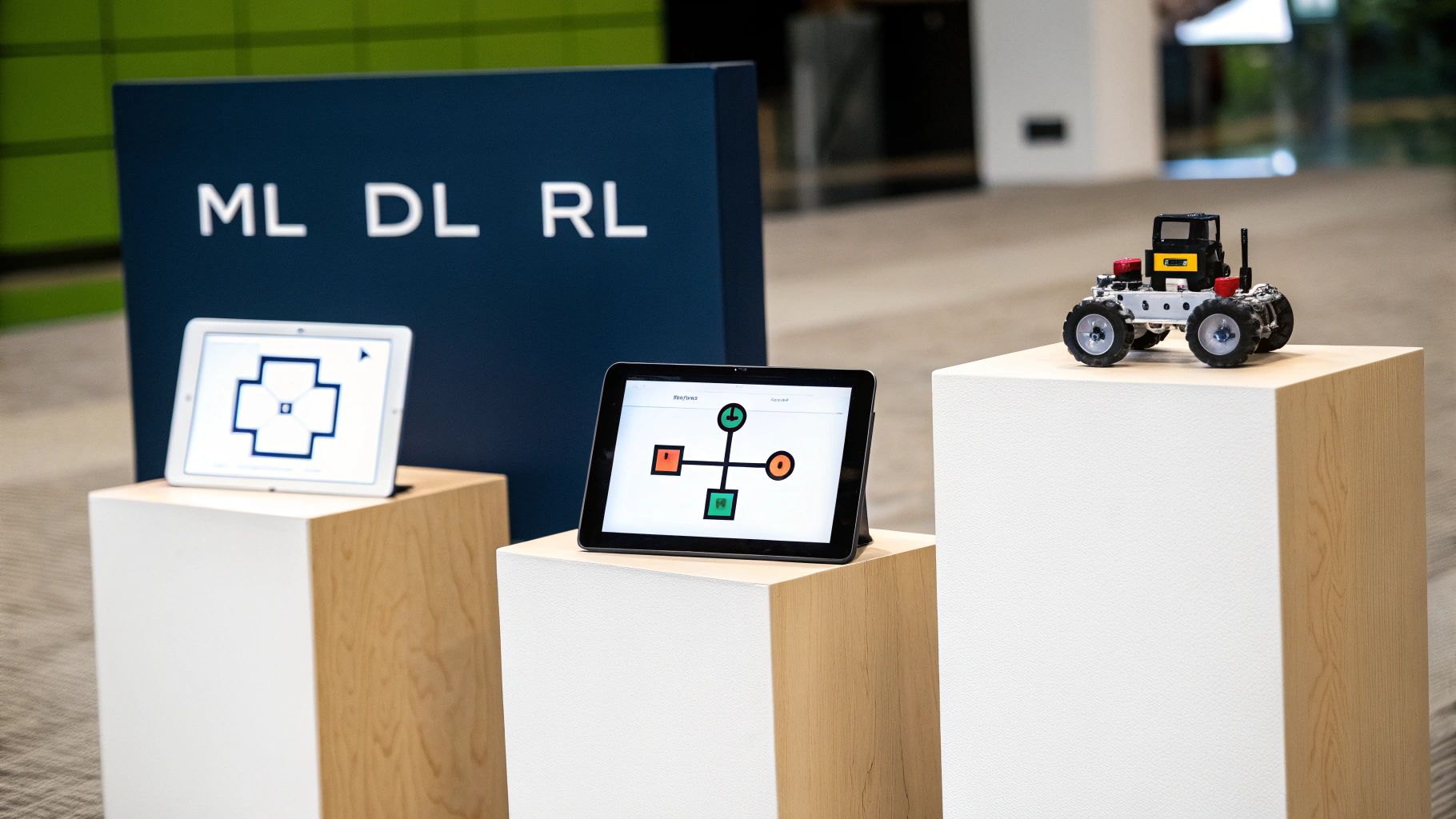
When we talk about using AI in forex, it isn't a single technology. It's a toolbox with different models, each designed for a specific job. The three main types you'll encounter are Machine Learning (ML), Deep Learning (DL), and Reinforcement Learning (RL).
Understanding what each model does—and its limitations—is the first practical step toward building a system that works for you. Think of it like hiring a team: some are great at analyzing past data, while others learn from live trial and error.
Machine Learning: The Veteran Pattern Spotter
Machine Learning is the most common form of AI used in trading today. Its purpose is to analyze historical data and make educated predictions about what might happen next. It’s like a seasoned chartist who has memorized how the market reacts under specific conditions.
For example, you could feed an ML model historical price data and technical indicator values. It might learn that when the RSI crosses above 70 while a bearish engulfing candle forms on the 1-hour chart, there's a 70% probability of a price reversal within the next four hours.
Common ML tasks in trading include:
- Trend Prediction: Classifying whether the market is likely to trend up, down, or remain range-bound.
- Volatility Forecasting: Predicting periods of high or low market volatility.
- Signal Generation: Identifying entry and exit points based on learned patterns.
This is a very practical starting point and forms the backbone of many automated systems. Exploring different strategies for algo trading is a great way to see these concepts in action.
Deep Learning: The Team of Specialists
Deep Learning is a more powerful—and complex—branch of Machine Learning. If ML is a single analyst, DL is an entire research team, with each member looking at the market from a different angle to find subtle connections.
DL models use "neural networks" with many layers, allowing them to process vast and unstructured datasets like news articles or social media posts. They can find faint, non-linear signals that drive price movements. A key advantage is that DL models can perform their own "feature engineering," meaning they can often figure out the most predictive data combinations on their own. However, they require massive amounts of data, are computationally expensive, and can be a "black box," making it hard to know why a trade was made.
Reinforcement Learning: The Trading Apprentice
Reinforcement Learning learns by doing—through trial and error in a simulated environment. Imagine a trading apprentice in a simulator, getting rewarded with virtual money for good trades and penalized for bad ones.
Over millions of simulated trades, the RL "agent" develops a "policy" (a strategy) that maximizes its long-term profit. This makes it a natural fit for dynamic decision-making processes.
Where you'll see RL used in forex:
- Optimal Trade Execution: Learning how to enter or exit a large position with minimal market impact.
- Dynamic Risk Management: Building position-sizing models that adjust automatically to changing market volatility.
- Full Strategy Development: Giving the agent a goal (e.g., "maximize Sharpe ratio") and letting it discover a complete trading system from scratch.
Comparing AI Models for Forex Trading
This table provides a quick cheat sheet for picking the right tool for your trading goals.
| AI Model Type | Primary Use in Forex | Analogy | Complexity |
|---|---|---|---|
| Machine Learning | Pattern recognition, signal generation, forecasting | A veteran chart analyst | Moderate |
| Deep Learning | Complex pattern detection, sentiment analysis | A team of research specialists | High |
| Reinforcement Learning | Optimal execution, dynamic risk management | A trading apprentice | Very High |
The best choice depends on your specific goal, the data you have available, and the level of complexity you're comfortable managing.
Sourcing and Preparing Data for Your AI Model
An AI model is only as smart as the data you feed it. The old saying, "garbage in, garbage out," is the absolute truth when building a system for AI in forex. Without clean, high-quality data, even the most sophisticated algorithm is just guessing.
Think of data as the foundation of your strategy. Let's get practical about where to find it and how to shape it into something your algorithms can use.
Finding the Right Data Sources
To make intelligent decisions, your model needs more than just price. The best AI strategies combine multiple data streams to get a complete picture of the market.
Here are the essential data types you should look for:
- Historical Price Data: This is your foundation. You need high-resolution data (ideally tick-level) that includes bid, ask, and volume. You can get this from brokers or third-party providers.
- Order Book Information: Data showing the depth of market (DOM) offers insight into short-term supply and demand.
- Economic Calendars: Your AI must be aware of major events like interest rate decisions (e.g., FOMC), Non-Farm Payrolls (NFP), and inflation reports (CPI).
- News and Sentiment Data: Modern AI can analyze news articles and social media to gauge market sentiment, which can be a valuable leading indicator.
Sourcing and cleaning data is a challenge. You must be meticulous about aligning timestamps across all sources to avoid "lookahead bias," where your model accidentally uses future information during training. This makes it look brilliant in tests but causes it to fail in live trading.
The Art of Feature Engineering
Once you have raw data, you need to transform it into meaningful inputs for your model. This process is called feature engineering. Think of it as creating your own custom, advanced technical indicators.
This step is where you inject your own market intuition into the model. Instead of just feeding it the raw EUR/USD price, you could engineer features like:
- Volatility Score: A feature that calculates the Average True Range (ATR) over the last 50 periods and compares it to the last 200 periods to spot unusual volatility spikes.
- Momentum Signal: A feature measuring the distance between the current price and a 20-period Exponential Moving Average (EMA), expressed as a percentage.
- Time-Based Features: Simple but powerful features like the day of the week or the hour of the day can help your model learn session-specific patterns (e.g., London vs. New York session behavior).
This process translates concepts from technical analysis into a mathematical language the AI can understand. Knowing how to create a forex strategy based on technical analysis is a huge help here, as you're essentially codifying those principles. A dozen well-designed features will always beat a thousand generic ones.
How to Backtest and Validate Your AI Strategies
Before letting an AI model trade with real money, you must prove it works. A simple backtest is not enough; it's easy to create a strategy that looks perfect in hindsight but fails in a live market.
Rigorous validation involves stress-testing your strategy against historical data to build confidence in its future performance. This is a non-negotiable step, especially if you're aiming to pass a prop firm challenge with strict drawdown rules.
The Dangers of Overfitting
The biggest trap in developing an AI trading model is overfitting. This happens when your algorithm learns the historical data too well, including random noise and one-off events that won't repeat. The result is a model with a beautiful backtest that breaks down as soon as it encounters new, live data.
To avoid this, split your historical data into three distinct sets:
- Training Set (60-70%): The largest portion, used by the AI to learn patterns and build its core logic.
- Validation Set (15-20%): A separate dataset used to tune the model's settings without touching the final test data.
- Test Set (15-20%): The final exam. This is "out-of-sample" data the model has never seen before. A solid performance here is the most honest signal you'll get about its potential real-world performance.
Think of it this way: the training set is the textbook, the validation set is your practice quiz, and the test set is the final exam.
Beyond a Simple Backtest: Walk-Forward Validation
A more robust method that mimics real trading is walk-forward validation. Instead of one large test, you break your data into chronological chunks.
Here’s the process:
- Train the model on one period (e.g., 2020 data).
- Test it on the next unseen period (e.g., Q1 2021).
- The window then "walks forward": train on 2020 through Q1 2021 and test on Q2 2021.
- Repeat this process over your entire dataset.
This forces the model to constantly adapt to new market conditions, giving you a much more realistic picture of its durability.
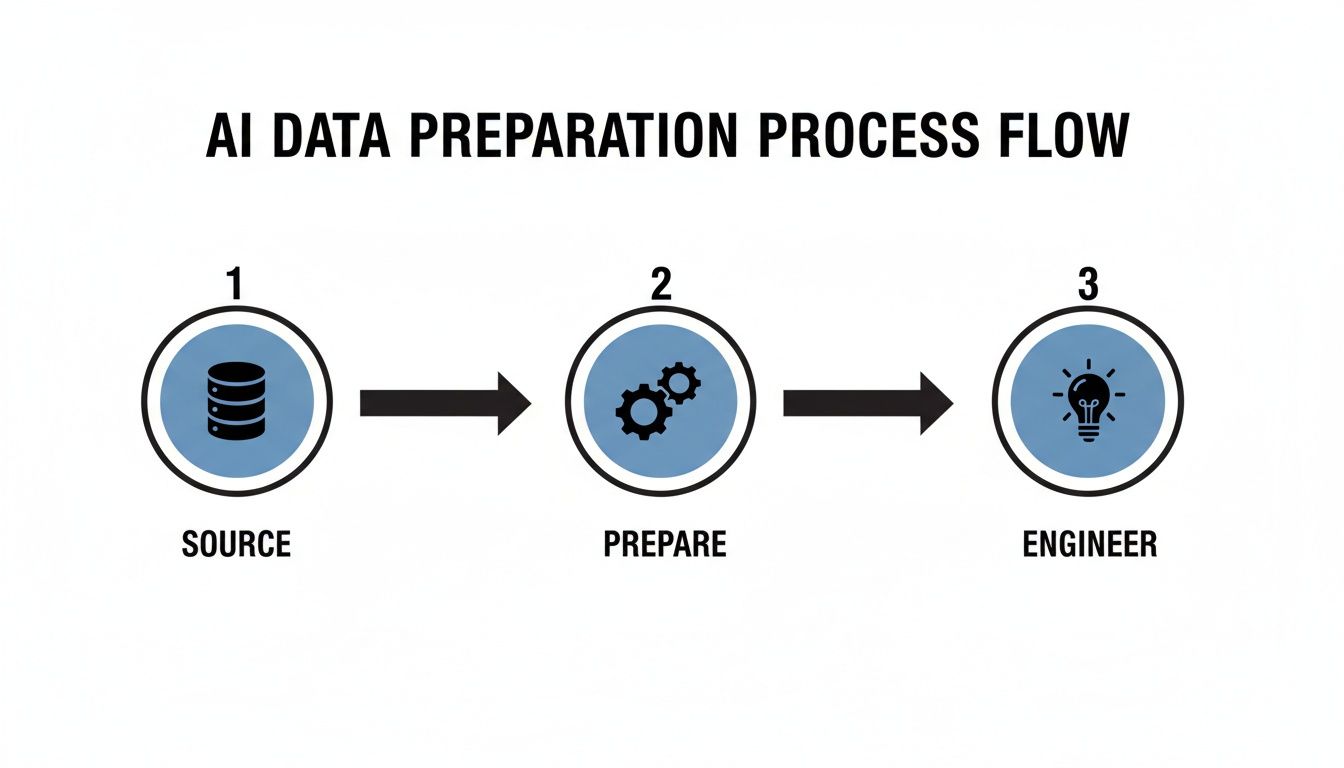
This workflow ensures the data you feed into your backtesting engine is clean and structured, which is critical for trustworthy results.
Key Metrics and Real-World Costs
When analyzing a backtest report, look beyond net profit. For prop firm traders, who must adhere to limits like a 5% daily and 10% total max drawdown, risk metrics are paramount.
Focus on these performance metrics:
- Max Drawdown: The largest peak-to-trough decline in equity. This is the most important risk metric.
- Sharpe Ratio: Measures risk-adjusted return. A ratio above 1.0 is generally considered strong.
- Profit Factor: Gross profits divided by gross losses. A value over 1.5 indicates that winners are significantly larger than losers.
- Win Rate & Average Win/Loss: Shows how often you win and the average size of your winning and losing trades.
Most importantly, your backtest must account for real-world trading costs. Forgetting these will produce fantasy results. Always include:
- Spreads: The bid-ask difference on every trade.
- Commissions: Brokerage fees for entering and exiting a position.
- Slippage: The difference between your expected fill price and the actual fill price, especially during volatile news events.
By 2026, AI trading is changing the game by enabling traders to test thousands of strategy variations in hours, reducing overfitting risk. Reports show this can boost win rates by 20-30% in backtests on major pairs. As an example, some AI platforms can scan historical data and flag that a specific London session reversal pattern fails 63% of the time, providing instant, actionable feedback.
Deploying Your AI and Managing Live Trading Risks
Moving your AI strategy from a backtest to a live account is where theory meets reality. Your model will now face real-time data feeds, unexpected volatility, and trading costs like slippage and commissions.
A successful launch requires a professional technical setup and a strict risk management framework. This is how you prepare for the unpredictability of live markets while operating within the tight boundaries of a prop firm.
Setting Up Your Live Trading Infrastructure
Running a serious trading algorithm from your personal laptop is not a viable option. A power outage or internet disconnection could be disastrous. The professional standard is a Virtual Private Server (VPS).
A VPS is a remote computer that runs 24/7 in a secure data center, often located near your broker's servers to minimize latency (delay). This ensures your AI is always online and can execute trades with precision.
Your deployment checklist should include:
- A reliable VPS provider: Look for hosts specializing in low-latency trading environments.
- A secure API connection: Your algorithm will communicate with your trading platform (like DXtrade or cTrader) via an Application Programming Interface (API). Ensure this connection is stable and secure.
- Real-time monitoring: Set up alerts that notify you immediately if the VPS goes offline or your trading script encounters an error.
Building Your Automated Risk Management System
With the infrastructure in place, the most critical step is building your automated safety net. Your AI must operate within a strict set of risk rules that you define before it places a single trade. The guiding principle is to protect capital first and seek profits second.
An automated strategy without an automated risk manager is a ticking time bomb. According to recent statistics, 65% of traders believe AI tools can significantly boost performance, especially for managing strict risk rules like a 5% daily drawdown limit. AI-driven risk tools can adjust position sizes based on live market volatility, helping traders pursue profit targets without breaching their maximum drawdown. You can find more insights on how AI is boosting trader performance on BestBrokers.com.
Non-Negotiable Risk Controls
Your risk management system needs multiple layers of defense. These controls aren't suggestions—they are hard-coded requirements. Effective risk management in forex trading is what separates a short-term gamble from a sustainable career.
Your system must include these essential controls:
-
The Master Kill Switch: A single command that can instantly shut down all trading, close all open positions, and cancel all pending orders. You need to be able to trigger this manually if you suspect something is wrong.
-
Hard Drawdown Limits: The system must constantly monitor account equity. If it approaches a critical drawdown level, it must halt all trading. For a prop firm account, you might set this at 4.5% daily loss instead of the hard 5% limit to create a buffer.
-
Dynamic Position Sizing: Never use a fixed lot size. Your AI should calculate position size for each trade based on a set risk percentage (e.g., 0.5% of the account) and current market volatility, often measured using the Average True Range (ATR).
-
Maximum Exposure Limits: Prevent the AI from over-trading or concentrating too much risk in one area. Set hard limits on the maximum number of open trades and total risk exposure to any single currency (e.g., cap total risk on all USD pairs at 2% of the account).
By building this framework, you're deploying a resilient, disciplined trading system designed to stay within the boundaries that keep you in the game.
Common Mistakes That Will Wreck Your AI Trading System
Building an AI trading system is exciting, but the path is full of common traps. Knowing these pitfalls from the start can be the difference between success and failure.
The most common and dangerous mistake is overfitting, where your model memorizes historical data—including random noise—instead of learning true, repeatable patterns. This leads to a spectacular backtest but disastrous live performance.
The Seduction of a "Perfect" Backtest
A related mistake is curve fitting, where you endlessly tweak parameters (e.g., changing a moving average from 20 to 21) until the historical results look perfect. This process tunes your strategy for the past and makes it fragile for the future.
A backtest that looks too good to be true is too good to be true. Real strategies have drawdowns and losing streaks. If your backtest doesn't, you have a problem.
The solution is disciplined testing. Always use separate datasets for training, validation, and out-of-sample testing to get a realistic assessment of your strategy's potential.
Trusting a Black Box With Your Capital
It's tempting to use a pre-built bot or copy-paste code without understanding its logic. This is the "black box" problem. If you don't know why the bot is making decisions, you can't tell if it's broken or just navigating a tough market period when it starts losing. You need to understand the core logic—what data it uses and the conditions it was built for. Without that, you're just gambling on someone else's code.
The financial industry is rapidly adopting this technology. Nearly 85% of firms expect to increase their use of AI by 2026, automating everything from research to execution. Professionals use these tools to gain an edge while adhering to strict risk limits, like a 5% daily drawdown. You can read more about the 2026 AI predictions on The TRADE to understand where the industry is headed.
Your Own Psychology Is Often the Weakest Link
Finally, the biggest failure point can be your own psychology. Even a sound AI strategy will have losing streaks. The worst mistake is interfering with your system when it hits one.
Watch out for these psychological errors:
- Manual Intervention: Manually closing a trade out of fear, which disrupts the system's statistical edge.
- Pulling the Plug Too Soon: Shutting the system down after a few losses, causing you to miss the winning trades that were statistically likely to follow.
- Constant Tinkering: Changing the AI's settings after every loss, which invalidates all your backtesting.
Building a profitable AI trading system is a marathon. It requires patient development, rigorous testing, and the discipline to let your validated strategy execute its plan.
FAQ: Your AI in Forex Questions Answered
Diving into AI for forex trading brings up a lot of questions. Here are clear, no-hype answers to some of the most common ones.
Do I need to be a programmer to use AI in trading?
No, not necessarily. While coding languages like Python offer the most flexibility for building custom strategies from scratch, it's no longer a requirement. A new generation of no-code and low-code platforms allows you to design, test, and deploy automated strategies using a visual, drag-and-drop interface. These tools let you focus on your trading logic and risk management rather than the technical details of coding.
Can AI predict the forex market with 100% accuracy?
Absolutely not. This is the biggest misconception about AI in forex. No system, human or machine, can predict the market with certainty. The forex market is influenced by countless unpredictable factors, from economic data to geopolitical events. The goal of AI is to identify a small but consistent statistical edge that can be profitable over a large number of trades. Remember, all trading involves a significant risk of loss.
Is an AI trading bot better than manual trading?
It depends on the trader and the strategy. Neither is definitively "better"—they just have different strengths and weaknesses.
-
AI Trading Bot:
- Emotionless: Executes trades based on logic, 24/7, without fear or greed.
- Speed: Analyzes data and executes orders in milliseconds.
- Discipline: Never deviates from its pre-programmed rules.
-
Manual Trader:
- Adaptability: Can use intuition and adapt to unique market contexts (like a central banker's speech) that an algorithm might misinterpret.
- Flexibility: Can decide not to trade in uncertain conditions, whereas a bot will trade any signal it receives.
Many successful traders use a hybrid approach, where AI handles data analysis and signal generation, but the trader makes the final execution decision.
Ready to apply your trading knowledge in a professional environment? At MyFundedCapital, we provide the capital and technology to help skilled traders succeed.
Explore our funding programs and find the account that matches your strategy.

